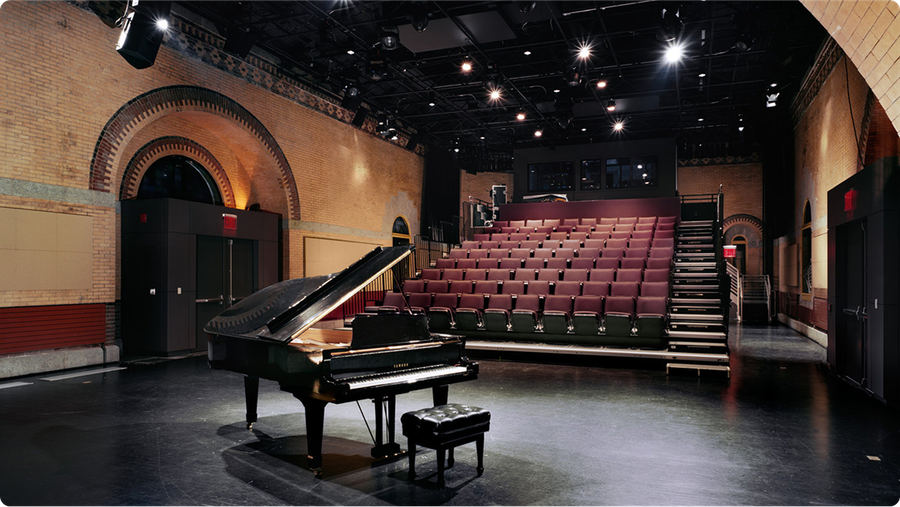
Our Venue
Venue Rentals
The Harlem Stage Gatehouse opens its doors to invite artists, community members, institutions, and more to host your event at our beautiful NYC landmark.
“The historic Gatehouse, itself a national landmark and a fantastic part of the City’s heritage, is a fitting home for one of New York’s leading performing arts centers.” — Former New York City Mayor Michael R. Bloomberg
Whether you’re planning a performance, corporate function, community forum, or private celebration, make your next event unforgettable at Harlem Stage. For more information about how to rent our space, please email leasing@harlemstage.org
Accessibility
Harlem Stage is committed to an inclusive, accessible, and welcoming experience for all visitors. The Harlem Stage Gatehouse is wheelchair-accessible throughout all areas of the venue. Audio-visual assistance is available for guests who are Deaf, hard of hearing, or hearing impaired, including assistive listening devices and captioning. Visitors who would like assistance are encouraged to contact us in advance at info@harlemstage.org so we can fully support your needs.
Venue History
Harlem Stage’s historic Gatehouse, designed by architect Frederick S. Cook, is nestled alongside The City College of New York, Aaron Davis Hall, and A. Philip Randolph High School, standing as a cultural beacon on the vibrant corner of 135th Street and Convent Avenue and welcoming New Yorkers from all walks of life. Once a vital part of the Croton Aqueduct system—a remarkable 19th-century engineering feat, constructed between 1884–1890 to provide fresh water to the city starting in 1890—this West Harlem landmark reflects the city’s rich legacy. Its Romanesque Revival architecture showcases both its grandeur and timeless beauty.
Land Acknowledgment
The Harlem Stage Gatehouse sits on land that was owned by the Lenape Tribes and was violently stolen, leading to the death, dispossession, and displacement of countless original inhabitants and owners of this land. The colonial initiative of the United States of America not only forcibly stole the land owned by Indigenous tribes, it also enslaved and exploited millions of Africans stolen from their land to build a free labor force under barbaric conditions that included the separation of families, brutal beatings, rape, and lynching. Harlem Stage seeks to partner with all communities, artists, and institutions of the Global Majority in the struggle for true equity and freedom.
Harlem Stage donates space to Indigenous organizations to support their work and a percentage of our annual revenue to an Indigenous community to move their work forward. Harlem Stage encourages all people to see this acknowledgment as a call to action to join our efforts and our mission to set untold stories free.
The Environment
Protecting the Planet
In this new era, Harlem Stage is creating a model for sustainable arts leadership while ensuring that our community remains at the heart of our work. Through green infrastructure, technological advancements, and thought-provoking programming, we will provide our community, in West Harlem, across New York City and the Country, and around the world, with a more welcoming, environmentally conscious gathering space that fosters both creativity and social responsibility.
Harlem Stage welcomes audiences from all walks of life to its in West Harlem. This historic site was once a part of the Croton Aqueduct system—a great engineering feat of the 19th century—which supplied much needed fresh drinking water to New York City, beginning in 1890, twenty-seven years following the Emancipation Proclamation. This new era at Harlem Stage will usher in technological and environmental innovation to reside within the DNA of this unique venue. From LED screens to light tracking systems to spatial audio systems and cutting-edge, state-of-art technological theatrical advancements, Harlem Stage is committed to being a one-of-a-kind technology meets artistry meets equity laboratory for artistic experimentation. Our values, as an organization, are also rooted in ensuring a sustainable planet. Because we see climate change as one of the most pressing issues of our time, we continue to honor environmental initiatives both in our operations and programming, including moving from a 60+ page season brochure to a dynamic one-page bifold with a QR Code and redirecting audiences to a digital playbill at events, which has reduced our carbon footprint by 2.5 tons this season alone.
Our next objective is to revitalize Harlem Stage’s outdoor space, turning it into a green sanctuary for public use. By incorporating native plants, shaded seating, and environmentally responsible design, we will create a space where community members can connect with nature, relax before and after performances, and participate in outdoor discussions and events. In a neighborhood where access to green space is limited, this initiative will provide a much-needed oasis for reflection, conversation, and artistic inspiration.
Covid 19
Harlem Stage takes every precaution to ensure the safety of our visitors and staff. Our facility is cleaned daily and masks are available upon request.